API Monitoring Service: The Buyer's Guide for Dev Teams
August 8, 2026
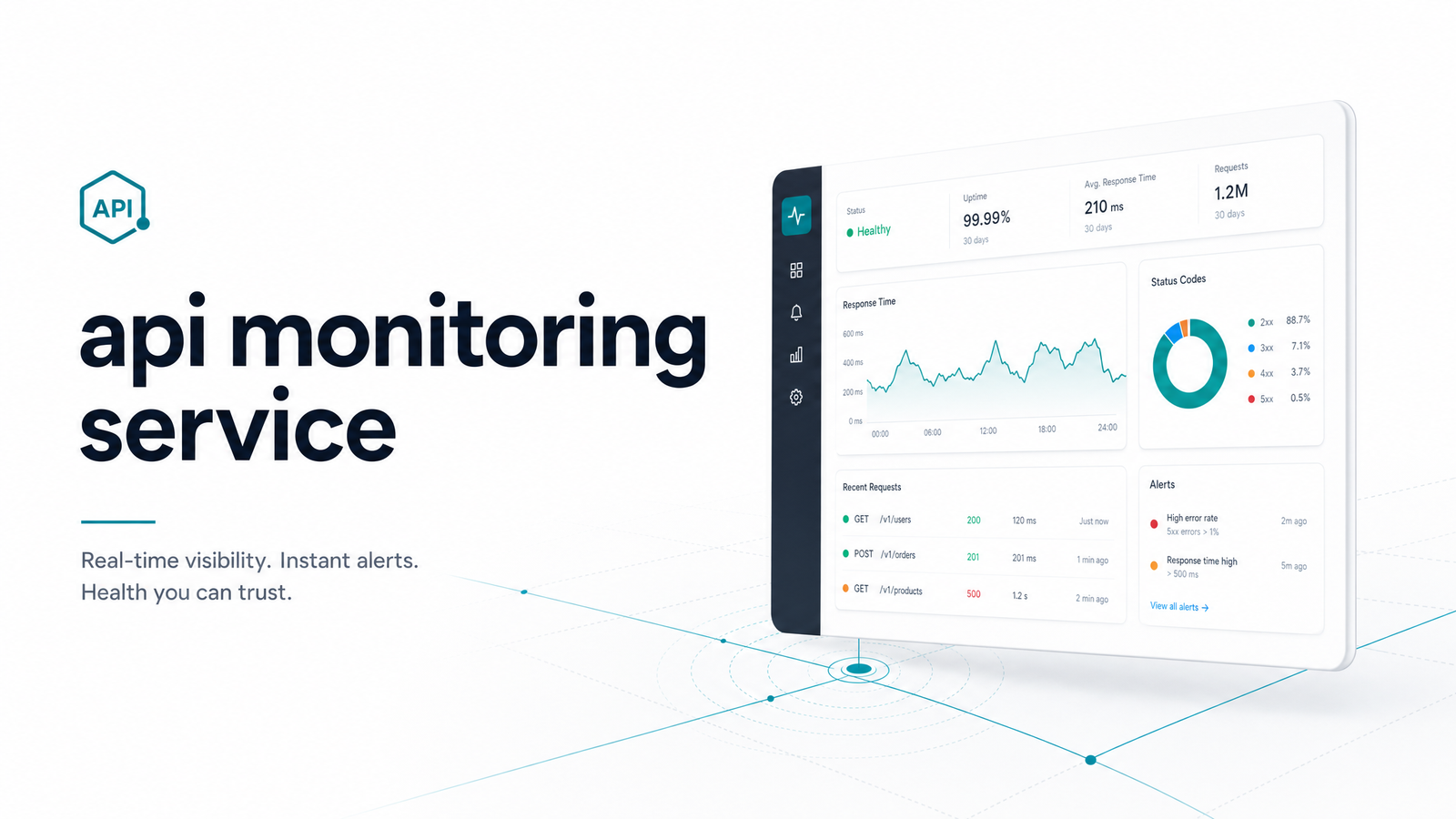
What Is an API Monitoring Service?
An API monitoring service continuously checks your endpoints for availability, correctness, and performance, then alerts you the moment behavior drifts from what's expected. That's a bigger job than "is the server up." A URL can respond in 40 milliseconds with a crisp 200 OK and still be lying to you — wrong payload, stale data, a broken downstream dependency, an authentication token quietly expired.
Real API monitoring sits between simple uptime checks on one side and full observability platforms on the other. The rest of this article treats "api monitoring service" as its own category, gives you a checklist to evaluate vendors against, and then focuses on a case most monitoring content skips — endpoints that don't get steady user traffic at all, but instead run on a schedule.
What a Real API Monitoring Service Should Do
Plenty of api monitoring tools are, underneath the marketing, a ping check with a nicer dashboard. Before you commit budget or engineering time, hold any candidate against this checklist:
- Availability checks with real HTTP semantics — not just "did it respond," but did it respond with the right status code, within an acceptable timeout, from the regions that matter to you.
- Response and schema validation — assertions on body content, headers, and structure, so a
200with an empty or malformed payload gets flagged instead of waved through. This is the core distinction between a basic api health check monitoring setup and one that actually catches logic failures. Checkly's documentation on API monitoring covers check assertions in more depth if you want vendor-neutral technical grounding. - Latency and performance tracking over time — trends matter more than single data points; a slow creep from 200ms to 2s tells you something a single check won't.
- Configurable alerting — thresholds you control, escalation paths, and routing to the tools your team already watches (Slack, PagerDuty, email, webhooks), instead of one-size-fits-all noise.
- Execution and run history — a searchable record of every check, every failure, every recovery, so incidents aren't reconstructed from memory.
- Integrations that fit your actual stack, not just a generic status page.
Frame these as evaluation criteria, not a feature list to skim. A vendor missing two or three of these isn't a lighter version of an api monitoring service — it's a different, narrower product wearing the same name.
API Monitoring vs. Uptime Monitoring vs. Observability
These three terms get used almost interchangeably in marketing copy, which causes real confusion when you're actually buying something.
Uptime monitoring is the narrowest: is the endpoint reachable, yes or no, usually on a fixed interval. It's useful and cheap, but it stops at availability — it won't tell you the response was wrong, slow, or logically broken. For the deeper limitations of uptime-only tools, this breakdown of what an uptime monitoring tool catches and misses covers that ground so this article doesn't need to repeat it.
API monitoring vs uptime monitoring, then, comes down to depth: monitoring adds correctness checks, latency trends, and alerting logic on top of the basic up/down signal. Middleware's explainer on API monitoring draws a similar line between testing, monitoring, and uptime checks if you want a second reference point.
API observability goes further, correlating real production traffic, traces, and logs to explain why something broke, not just that it broke. Traditional API monitoring — including most services in this category — is fundamentally blackbox: synthetic checks fired on a schedule or trigger, rather than analysis of live traffic. Moesif's comparison of API observability and API monitoring explains this blackbox nature well, and it's exactly why observability platforms like those built on OpenTelemetry solve a different problem than a monitoring service does. Most teams need monitoring first; observability is a later addition once traffic and complexity justify it.
The Blind Spot: APIs That Only Run on a Schedule
Here's where most api monitoring services quietly assume something untrue for a large chunk of real infrastructure: steady, user-driven traffic. Their model — check every N minutes, alert on downtime, track latency against a baseline — works well for a public API getting constant requests.
It falls apart for endpoints only invoked by a cron job, a queue worker, or a webhook trigger. Nobody is hammering that URL every few seconds. If the scheduled run doesn't fire, or fires and returns a 200 while the actual job logic silently fails, there's no user around to notice. Uptime percentage becomes almost meaningless here — the endpoint was "up" the whole time; it just never got called, or got called and did nothing useful.
This is the exact scenario this look at cron job examples and why they fail silently walks through with concrete cases: a nightly billing job that returns success but skips half the records, a data sync that never runs because the scheduler itself died, a webhook handler that 200s an error payload. Scheduled api monitoring needs to flip the priority order — run history and recovery alerting matter more than a percentage uptime badge, because the failure mode isn't "down," it's "silent." Cron job api monitoring means tracking whether the expected run happened at all, whether it completed, and what it actually returned — not just whether the endpoint could theoretically respond.
How to Choose an API Monitoring Service
Before picking a tool, work through five questions honestly:
- What's your traffic pattern? Constant user traffic favors general-purpose api monitoring tools. Scheduled or trigger-based calls need a service built around expected run history, not steady polling.
- What's your alert fatigue tolerance? A tool that pages you for every transient blip trains your team to ignore alerts entirely.
- What integrations do you actually need? Slack and PagerDuty support are table stakes now; check for webhook flexibility too.
- What's the pricing model? Per-check, per-monitor, and flat-tier pricing behave very differently as you scale endpoints.
- SaaS or self-hosted? Compliance and infrastructure constraints sometimes decide this before features do.
If your answer to question one is "our critical endpoints are cron-driven, not user-driven," you're evaluating the wrong category of tool if you stop at generic uptime checkers. That's the specific gap Cronevra is built for: monitoring scheduled and triggered HTTP jobs, tracking whether each run actually happened and succeeded, and alerting on recovery — not just on downtime. Cronevra's homepage walks through how that works, and the pricing page lays out plans if you're ready to compare against what you're currently using.
Frequently Asked Questions
Is an API monitoring service the same as an uptime monitor?
No — uptime monitoring only checks whether an endpoint responds, while an API monitoring service also validates response correctness, tracks latency trends, and provides configurable alerting and run history. Uptime monitoring is effectively a subset of a full API monitoring service.
Can an API monitoring service catch a job that runs but fails silently?
Only if it validates response content and tracks expected run history, not just HTTP status codes. A basic ping check will mark a job "healthy" as long as it gets a 200, even if the underlying logic failed — this is exactly the gap scheduled/cron-focused monitoring is designed to close.
Do I need an API monitoring service if I already have application logs?
Yes, because logs are passive and only useful after you know to look for a problem. A monitoring service actively checks and alerts in real time, often catching failures before anyone reviews the logs at all.
How often should an API monitoring service check an endpoint?
It depends on the endpoint's traffic pattern and criticality — high-traffic public APIs often warrant checks every one to five minutes, while scheduled jobs should be monitored against their expected run schedule rather than a fixed interval. For cron-driven endpoints, the right cadence matches the job's schedule, not an arbitrary polling frequency.
What's the difference between API monitoring and API observability?
API monitoring is blackbox: it runs synthetic checks on a schedule or trigger to see if endpoints behave as expected. API observability correlates real production traffic, logs, and traces to explain why a failure happened, and typically requires more instrumentation, such as OpenTelemetry.
Is API monitoring worth it for internal or scheduled-only endpoints, not just public APIs?
Yes — arguably more so, since internal and scheduled-only endpoints have no end users to notice or report a failure. Without dedicated monitoring, a silently broken cron job or internal webhook can go unnoticed for days.
If your critical "API" is really a set of cron jobs, scheduled tasks, or webhook triggers rather than steady user traffic, that's precisely the situation Cronevra was built for — give it a look before you settle for a monitoring tool designed around the wrong traffic pattern.